
The Case for Brands to Implement a Local Social Advertising Program
A common thinking is that if you’re a national brand, you should be doing national advertising. The reality is that despite how large your brand is, 75% of all transactions still occur at a local retailer. We’re not saying national advertising doesn’t have its place, but by only focusing on brand-level advertising, you’re missing out on a huge portion of your market. This is more contrarian than you realize for three primary reasons.
Social Media is a Community Platform
Facebook and Instagram, is about connecting with people you know and connecting with your community. That makes national advertising counter-intuitive to the nature of the platform itself – a proverbial orange in the apple cart. Yet Facebook’s communal approach makes it the perfect venue for the 90 million small and medium-sized businesses with Pages on the platform, 88% of which advertise on the platform. Combine those stats with knowing the average user clicks on 12 ads per month, and it becomes incredibly obvious that since Facebook is a community platform, it should be treated as such by your marketing team.
Not Every Place is the Same
The Cleveland DMA (Designated Market Area) ranges from active downtown, to bustling suburbs, to expansive farmland. At a macro level, New York City may differ vastly from Miami, but within these cities, there’s a different culture and lingo depending on what borough or area you live in. While proximity matters, local personality and cultural norms matter too. For example, if you’re trying to advertise bicycles, your creative will want to address where people typically ride in those areas, (city bikes vs beach bikes vs mountain or trail bikes), and even what they wear while riding.
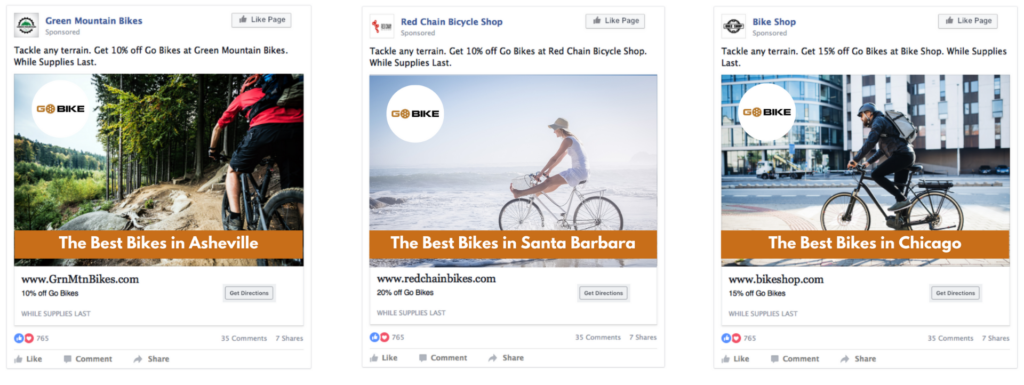
Because Facebook is communal, you have to reflect relevant cultural norms if you want to see a higher level of engagement. A national or even DMA-level ad only allows you to speak about yourself, not about who you’re talking to.
Local Social Advertising Just Performs Better
It’s no wonder that marketers tend to think of Facebook and Instagram advertising as a top of the funnel activity because so many times campaigns that are branding-built are too general to effectively use the power of the social platform. Local campaigns show 2-3x more conversions* than national campaigns. Time and time again we find that marketers are able to collapse the funnel by driving things down not only to a local level, but a culturally-relevant level all the way down to the individual retailer. Local social advertising allows you to reflect your brand from initial exposure to your product all the way down to where consumers can hold it in their hand.
*Tiger Pistol Internal Data
Related Posts

The Growing Importance of Loyalty Programs in QSRs: Challenges and Opportunities
Loyalty programs have become essential for quick-service restaurants (QSRs) to maintain customer relationships, drive repeat visits, and boost sales. With 81% of Americans holding a QSR loyalty membership and 63% for full-service restaurants, the prevalence of loyalty programs continues to grow. However, while the widespread adoption of these programs demonstra

Brands Dial Up Local Social Advertising Budgets Amid Economic Downturn
In a recent article published by Franchise Update Media, Tiger Pistol CEO Paul Elliott reveals a surprising trend: Franchise brands are increasing their local social advertising budgets amidst the economic downturn. Elliott says this trend is vital to supporting the health of all franchisees. “Local campaigns help brands and their franchisees spend more

Meta’s Performance 5 Framework: Using Automation Tools to Optimize Campaigns
Meta’s Performance 5 Framework revolutionizes advertisers’ performance by implementing five powerful best practices that amplify results when using Meta’s ad products. In the third part of our series, exploring the Performance 5 Framework, we dive into recommendation number two: Use Automation Tools to Optimize Campaigns. The Power of Automati

The New Economics of SMB Local Advertising: How AI Automation Expands Marketing Reseller Profitability
Local advertising momentum continues to accelerate, and SMB advertisers sit at the center of that growth. Restaurants, real estate firms, education providers, and service businesses increase spending as they chase local relevance across search, social, video, and emerging formats. BIA projects $173 billion in U.S. local media spend in 2026, with digital capturi